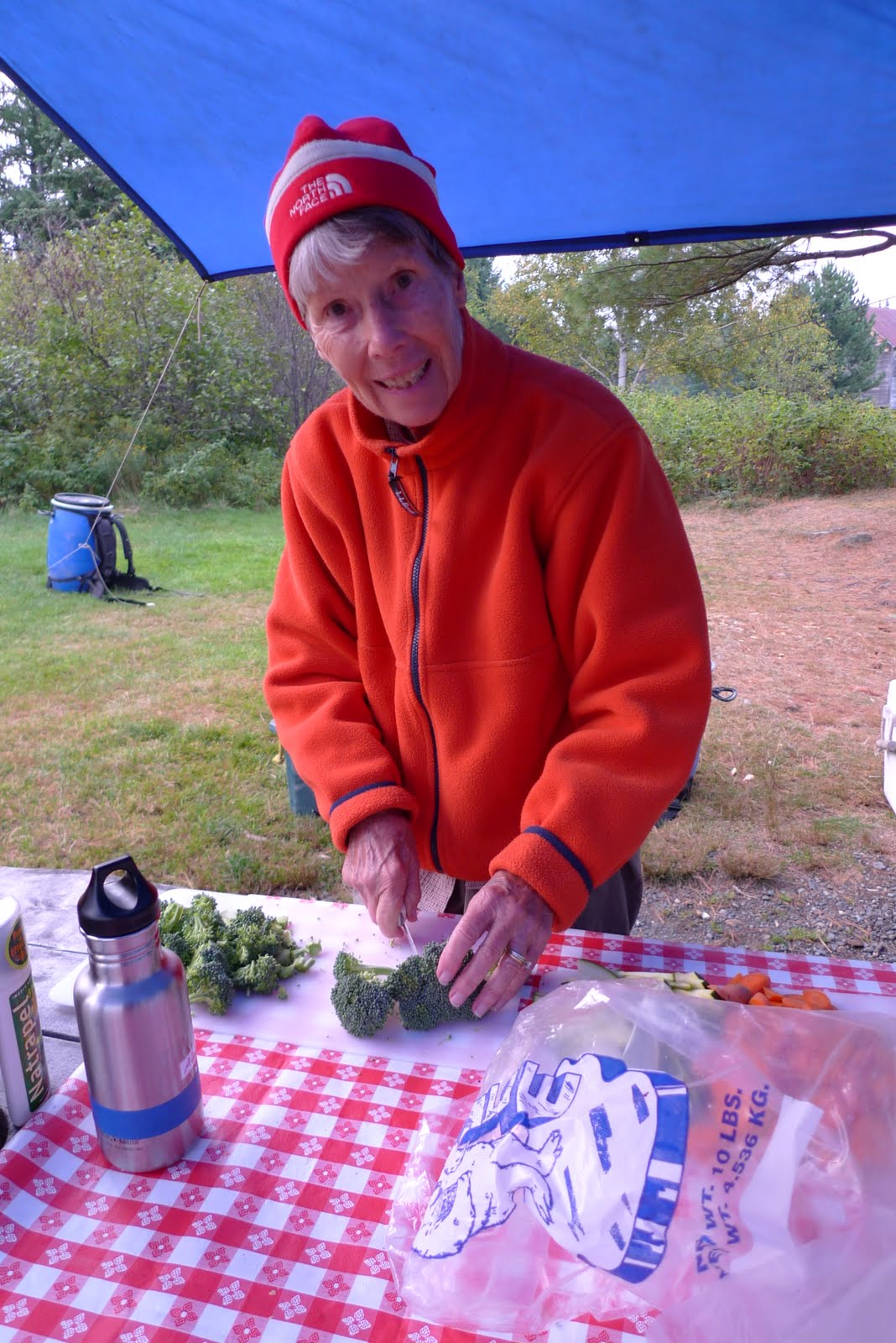
With a stop for fuel and a trailor-side picnic lunch in Fort Kent, van trouble requiring a stop at Midway and a stop once again in Bangor to drop off two of our new friends meeting their ride to Bar Harbor, we arrived at Chewonki at 6:30.
14 September 2010
Pull outs, drop offs, arrivals
With a stop for fuel and a trailor-side picnic lunch in Fort Kent, van trouble requiring a stop at Midway and a stop once again in Bangor to drop off two of our new friends meeting their ride to Bar Harbor, we arrived at Chewonki at 6:30.
10 September 2010
Into the water
Paddling ten miles in the dreary chill, however, was not without its beauty. In fact, the entire distance was in the river (no lakes or ponds to traverse), a narrow, meandering ribbon with stretches of serene flat water breaking up the more challenging shallow water with its rips, rocks and rapids. Tal commented more than once through the day that "this" is what he came here for.
It is mid-to-late afternoon as I write this and our camp on Round Pond is set up, again the rain abating during that process. Several of us have been in the water. Including me! And, how was it? Cold? Bracing, breathtaking, brutal. But, refreshing. I am grateful for having brought both the bathing suit and the felt-like microfiber camp towel. Though we cannot actually bathe, I did with biodegradable camp soap manage to wash my slicked-to-the-head dirty hair. The rinse had to be done on the shore in a water-filled bucket, the rinse water then poured out several feet up inland so it would filter through shrubs, grass and rocks before returning to the Allagash.
And, now, at the moment we're all gathered around the table -- warm drink in hand and warm fire nearby. Supper (of mac'n cheese) is underway with the chocolate cake having been put on the fire first. Colin and Tal definitely have the best seat in the house.
09 September 2010
A long haul
We have camped at the ruins of the Long Lake Dam, a very picturesque spot. The ruins of the dam might seem runnable both from the water and from the campsite bluff, but the literature I've seen suggests strongly trying it to be a bad idea, there being submerged spikes which could seriously damage a canoe. A short portage is required, so the canoes were brought out of the water and to the campsite for the night.
This afternoon has provided Tal the second opportunity he has had to use his flyrod, the first having been at Churchill Dam Tuesday afternoon. While none of the fishermen in the group (Colin, Eric, Tal) have caught anything they could keep, watching them in action is a pleasure.
08 September 2010
Chase Rapids
I rained some in the night and we awoke to a steady rain. Alana amazed me with breakfast. Had I been in her position, facing rain and a challenging section of water with several novice paddlers, likely I would have served cold cereal and bagels, something quick and simple. A reflection of my anxiety, I judge. She and Colin, on the other hand, produced bacon and blueberry pancakes with Vermont maple syrup over a fire!
The rain kept falling, though, and the water wasn't going to get any higher. We had to set out.
This photograph is one taken by Colin in sweep position just as we left the dam. The first rapid is around the curve in the river to the left. I am grateful to Colin for having documented the group's passage, as all of us kept our cameras stowed in our waterproof day bags and pretty much had all we could handle in the rushing water presenting itself to us.
Within a couple of hours we'd done it with only one mishap. A canoe went over on the second rapid and as serious as it could have been the paddlers did what they'd been instructed to do during yesterday's practice and Alana and Colin's extensive training at Chewonki became evident immediately. Tal and I were the fourth canoe in the line, so we eddied out and waited until everyone was back in the proper boat and the water was clear. We had our turn without having anyone to follow to show the way and we did fine. It wasn't all easy after that, but I settled down, realizing that all we had to do, all we could do, was follow when we were able to see a canoe in front of us, try to read the water no matter what and take the river as it came.We stopped at the site of the former Bissonnette Bridge where our gear had been deposited to reload the canoes and for a relaxing lunch break. Alana's tuna salad was exceptionally magnificent! Even the outhouse was deserving of its own photo. I suspect it was pure relief that enlivened my reactions to the ordinary to such a heightened degree.
In this downstream view our reloaded canoes await the next leg of our journey.
07 September 2010
Practice
In addition to the sound of the Allagash, a soft, slow rain made a wonderful noise on the tarp covering the table and fireplace. It was a sound completely different from what I would have been hearing had I been in the tent writing. It had been a busy day to that point with paddling in the morning, setting up camp after lunch and practice on the river before free time.
So, the practice. Colin and Alana presented an overview of how to read fast water, what to do in the case of a tipped canoe (and what they would be doing) and then had us put the canoes in the fast water on the downstream side of the dam. There we practiced ferrying (crossing moving water without losing ground), prys and draws (to turn the canoe quickly), eddying in and out of the current. Most important? Don't follow to closely, if in trouble blow the whistle attached to one's PFD, have fun. Yeah, right. The thought crossed my mind that we won't know how well we learned those techniques during our practice session until we're put to the test in the Chase Rapids tomorrow.
Needless to say, a nap called after all that. Then it was time to begin supper. That activity is well underway in the photograph below.
Seems as though practice in camp is paying off. I do hope the same holds true for our pre-rapid practice in the water earlier in the afternoon.
Headwinds
Colin was in the single canoe in sweep position; he recommended that we paddle to the bank on the back side of the point, which we did. Exhausted, we carried our personal gear up the shore to the campsite. We weren't quite alone in our failure, but we didn't make it by a considerably larger margin than a few of the others. Colin assisted folks with gear while Alana and Eric ferried canoes. What a beginning.
But, Scofield Point was certainly worth the pain, I must say. As we set up our tent and camp life was established, the wind died down and we took a short walk along the bank soaking up the stillness and the quiet.
We arrived and ate late enough that we needed headlamps again before the cleanup was finished, but what a meal -- a delicious concoction of black beans and salsa, sauteed onion and ground meat for burritos and a dessert of ginger-brownie cake baked over the campfire. Divine! Have I mentioned that Alana is a personal chef?
It rained in the night, a nice sound on the tent fly. And, as Tal and I were waking in the pre-dawn, we heard very distinct footsteps outside and moving past our tent. Moments later came a terrible snap followed by a loud crash. A moose had come through the campsite, getting tangled in one of the lines securing the tarp over the table and fireplace. Very exciting! We should have seen moose eating in the marshy area at the back of the point after dawn, but with the unusual wind direction continuing overnight, they with their acute sense of smell stayed away.
With the overnight rain came a change in wind direction to what Alana and Colin had expected for yesterday. So, today we paddled back to Churchill Dam with -- a headwind. Somehow, we were more ready for it today than yesterday and, though hard, we kept up pretty well.
05 September 2010
To Chewonki ... and beyond
At a Dysarts truck stop in Bangor we rendezvoused with our final two group members, a father and son -- Ron and Eric, Ron from Maine and Eric from Idaho. Although at a little after 4:00 we were officially together and on our way, it wasn't until we left I-95 at Medway/East Millinocket and headed into Maine's interior that the remoteness of what we were about to do began to sink in for me.
It was dusk before we pulled into Chewonki's Big Eddy Campground on the Golden Road (which runs from Millinocket to the Canadian border and is the most active logging road in New England) and the West Branch of the Penobscot River, just outside Baxter State Park. It was there that we learned to pitch out tents and had our first meal cooked over a fire -- both activities accomplished in the dark. Now I understand why headlamps, rather than flashlights, were so highly recommended on our equipment lists ...